
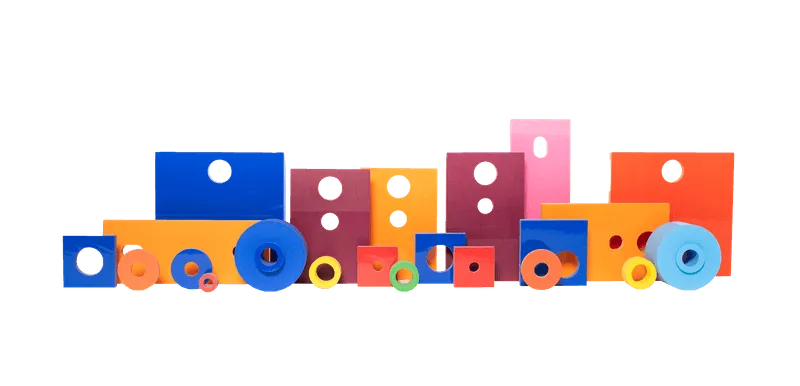
Diepolast®
Diepolast® is an advanced polyether-based elastomer, developed for outstanding vibration insulation and effective structure-borne noise decoupling under various pressure and shear loads.
Diepolast® offers a wide range of solutions for vibration isolation and sound damping in demanding environments. Available in mixed-cell and closed-cell standard grades for heavy loads, Diepolast provides tailor-made applications for engine mounts, machine feet, elastic intermediate layers, and soundproofing in floors and ceilings. Its unique cell structure prevents liquid absorption even when submerged, making it particularly suitable for use under challenging conditions.
An overview of the property profile:
- Broad load ranges
- Excellent vibration damping and insulation
- Suitable for pressure and shear loads
- Good hydrolysis resistance
- Temperature range from -30°C to +70°C
- Density: 165 - approx. 1,000 kg/m³
- Low compression set
- Excellent decoupling properties
- Can be used for source or receiver isolation
- Good resistance to many chemicals and oils
Products specially developed by P+S:
- Engine mounts, machine feet, elastic interlayers
- Soundproofing for floors and ceilings
- Buffers and decoupling elements
FAQs
Find answers to our most frequently asked questions here:
Diepolast® is used for vibration isolation and sound insulation in mechanical engineering, construction and many other fields – for example in machine feet and foundations, engine mounts, elastic intermediate layers, structure-borne noise isolation and vibration dampers. The material can isolate both the source of vibration and the receiver; the design is determined for the specific application based on load, area and the existing natural frequency.
Low settlement means that under sustained load Diepolast® largely retains its installed height, and thus its elastic properties, over its service life. This ensures a constant decoupling and damping effect without the component yielding over time. How much settlement occurs depends on load, temperature, service life, geometry and the selected grade.
Diepolast® is available in a very wide density range from 165 to approx. 1,000 kg/m³ and is designed for an operating range of -30 °C to +70 °C. The mixed- and closed-cell polyether grades allow the spring characteristic to be adapted to different loads and also to humid environments; the selection depends on load, contact area, component height and natural frequency.
Diepolast® is used for vibration isolation and structure-borne noise decoupling and is therefore often requested as an alternative to materials such as Sylomer®, Sylodyn®, Regupol® or Regufoam®. It is available in a wide density range from 165 to around 1,000 kg/m³, designed for -30 °C to +70 °C and offered in mixed- and closed-cell, hydrolysis-resistant polyether grades. The various grades allow the spring characteristic to be adapted to the respective load. Which one fits in a given case depends on load, contact area, component height and natural frequency.