
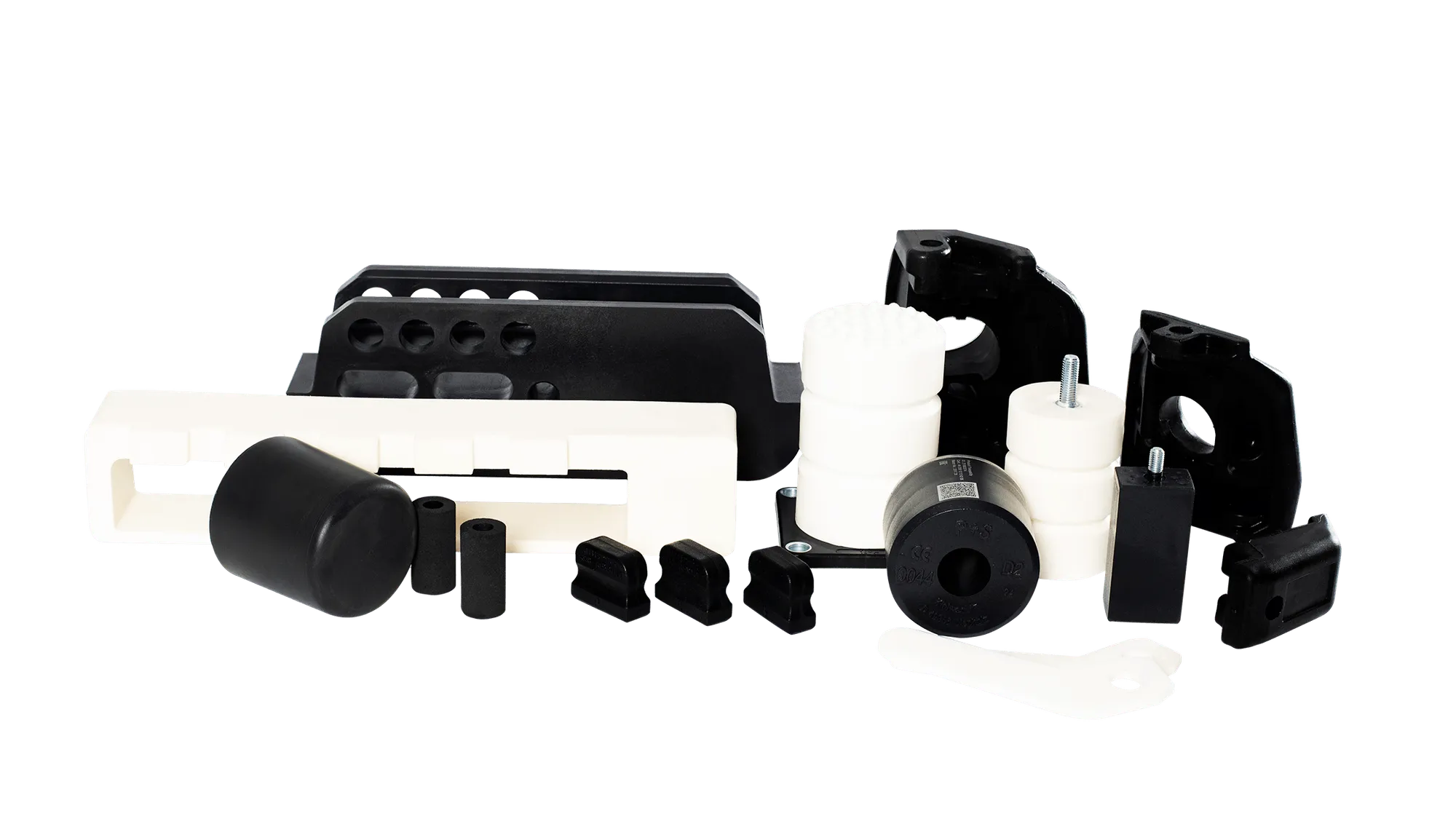
Diepocell®
Diepocell® are mixed-cell polyurethane elastomers characterized by excellent damping properties. They are ideal for applications requiring maximum energy absorption and excellent formability under extreme conditions.
The Diepocell® materials BM and MH form a family of materials that is particularly appreciated for their damping properties. The recipes, based on high-quality polyester and polyether polyols, meet strict technical requirements and are particularly effective in safety components in elevators and emergency buffers in crane systems. Their high deformability and low lateral expansion make them ideal for use in extreme environments, including tropical climates.
Property profile overview:
- Excellent damping properties
- Maximum energy absorption
- Uniform compressive deformation behavior
- High volume compressibility with low lateral strain
- Good resistance to mineral oils and greases
- Good resistance to ozone and UV radiation
- Temperature range from -30°C to +80°C
- Density: 300 - 800 kg/m³
- Hydrolysis-resistant versions available on request
- Special grades approved in accordance with LFGB
Products specially developed by P+S:
- Stroke buffers
- Molded parts
- Semi-finished products for further processing
- Attachment buffers for the elevator industry
FAQs
Find answers to our most frequently asked questions here:
Diepocell® is suitable when kinetic energy under a high load must be absorbed in a controlled manner (impact loading). Typical applications include lift and end-stop buffers, impact buffers in elevator systems, emergency buffers in crane systems, and other safety components. High deformability and outstanding damping behavior ensure low rebound. The kinetic energy is absorbed almost completely, protecting the adjacent structure.
Diepocell® is designed for maximum energy absorption and safety/buffer applications, while Vulkocell® is better suited for auxiliary springs, shock absorbers, and sealing elements with high recovery. When the goal is to absorb energy in an emergency, Diepocell® is the first choice; when recurring spring and damping tasks are involved, Vulkocell® is more suitable. The final selection depends on energy input, deflection, and the purpose of the component in the application.
Diepocell® is available in specially formulated, hydrolysis-resistant versions whose damping properties and mechanical integrity are retained even under continuously high humidity and in tropical climates. The standard density is 300–800 kg/m³ and the operating range is -30 °C to +80 °C. The right grade is selected based on the load and energy requirements.
Diepocell® is designed for maximum energy absorption and is used for the same buffering and safety applications as cellular polyurethanes sometimes marketed as Autan®, Eutan®, or simply as polyurethane foam. The standard density is 300 to 800 kg/m³ and the operating range is -30 °C to +80 °C; characteristic features are its high volume compressibility with low transverse strain and hydrolysis-resistant versions. In use, it can be found, for example, as impact buffers in elevator systems, as emergency buffers in crane systems, and in similar safety components. If the application requires spring action rather than impact damping, Vulkocell® is the better choice; the decisive factors are energy input, deflection, and the purpose of the component.